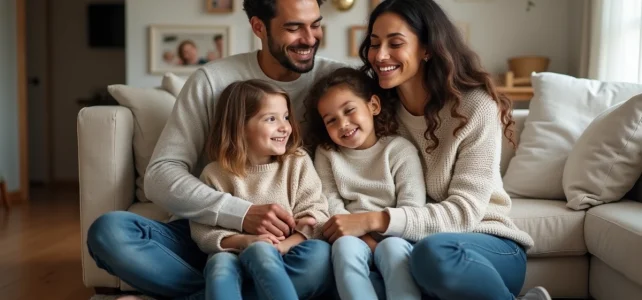
In France, the approval issued by the departmental council is valid for five years, but it never guarantees the placement of a child. Waiting times vary significantly depending on the child’s background, the profile of the adoptive parents, or the chosen modality. Less than 10% of candidates achieve an adoption each year, despite the existence of several official pathways.
The process involves strict procedures, multiple interviews, and sometimes unknown criteria. Some families report experiences that are very different from the expected administrative processes. Regional disparities and recent changes in the legal framework raise new questions at every stage.
You may also like : Everything You Need to Know to Know the Distance Between Montreal and Quebec
Adoption in France today: understanding the stakes and realities
Adopting in France means navigating a regulated territory, where each family carves out its own path. Two legal forms dominate: full adoption, which erases the original lineage and makes the adopted child legally indistinguishable from a biological child, and simple adoption, which preserves certain ties with the biological family. These frameworks reshape the notion of family, inviting a rethinking of the meaning of home and parental authority.
On the numbers side, the contrast is striking: many candidate families, few adoptable children. The procedures are lengthy, waiting becomes a constant, while interviews with the administration test the motivation and preparation of prospective parents. International adoption continues to decline, while the national route, with state wards, remains extremely limited.
Related reading : Everything You Need to Know About Dogs: Breeds, Tips, and Tricks to Understand Them Well
Everyone moves forward with their questions, often guided by associations, support groups, or resources such as adopcje.org, which shed light on the issues of attachment, integration, and transmission. Any adoption project requires reflection on parenthood, the child’s place, and the family dynamics that will emerge.
This diversity of responses, both legal and human, shapes unique stories. Each adoption charts a singular path, balancing the search for equilibrium, legal recognition, and the construction of lasting emotional security.
What are the key steps to adopt a child?
The adoption process in France is organized around essential steps, defined by law and implemented by institutions. It all begins with the approval, issued by the departmental council. This file, meticulously examined, prompts reflection on one’s intentions, abilities to welcome a child, and is subject to the careful scrutiny of social services.
Interviews with the child welfare service and a psychologist thoroughly examine the family project, the stability of the couple or the individual, as well as the environment proposed for the child. One should expect at least nine months between the application and the decision of the president of the departmental council. This period, often difficult to endure, forges the coherence of the parental project.
Here are the main steps that mark the adoption process in France:
- Obtaining approval
- Registration on the departmental or national list
- Orientation towards national adoption (state wards) or international adoption
- Matching with a child proposed by the family council of state wards
- Connecting and adaptation period
- Adoption judgment pronounced by the court
This journey requires a great capacity for patience and adaptability. For the adoption of a spouse’s child, the procedure is more straightforward but remains subject to the judge’s discretion. Behind the forms and appointments, it is primarily about preparing for the arrival of a child who will gradually take their place within the family, both emotionally and legally.
Words from families: practical advice and inspiring testimonies
Building an adoptive family requires, above all, listening, being patient, and accepting the unexpected. The testimonies collected outline very different journeys that break with preconceived notions. Émilie, mother of a boy adopted at the age of five, summarizes her experience: “The wait was long, but it allowed us to better define our project and reflect on the place the child would take in our story.”
Many families emphasize the role of support, starting from the approval request phase. Guidance from a psychologist or an association, sharing experiences with other waiting parents, fosters a more serene and realistic approach. Many also stress the importance of sharing doubts, hopes, and questions with those who have already gone through this often uncertain journey.
Some pieces of advice frequently appear in the accounts of adoptive families:
- Respect the child’s pace and allow the attachment bond to develop naturally
- Address adoption openly, from the early years
- Prepare discussions about origins and the place of the biological family
Some have found valuable help through the national council for access to personal origins, which supports children and their families in seeking information and meaning. Others emphasize the stability provided by their surroundings and the ability to rely on loved ones. All describe a common thread: trust, perseverance, and recognition of each identity weave the fabric of a unique family story, where everyone ultimately finds their place.