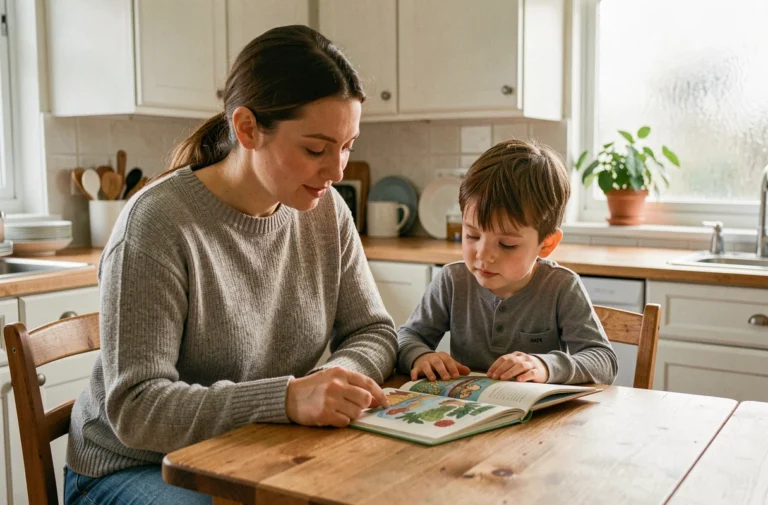
A child crying at 3 AM, a meal spilled just before leaving, a tantrum at the supermarket. Parental daily life unfolds in these micro-moments where fatigue and doubt set in. Supporting parents means providing them with concrete guidelines on the issues that really matter: sleep, screens, mental load, and the rights that exist to take a breather.
Birth Leave 2026: A Recent Right That Changes the Game for Parents
Practical advice is not enough if parents lack the time to implement it. Since July 1, 2026, birth leave allows each parent to take one or two additional months after the arrival of a child. This measure adds to the existing maternity, paternity, and adoption leaves.
The compensation reaches 70% of the net salary in the first month, then 60% in the second, within the limits of the Social Security ceiling. This is not a symbolic leave: it offers a real window to establish routines, rest, and share the load between both parents.
To find information about parents on Naturally Mom, particularly on family organization and the first weeks with a baby, this type of resource complements the reading of official texts usefully.
Have you noticed that a rested parent reacts differently to a tantrum? This leave aims exactly at that: providing time before exhaustion sets in. The challenge remains that some employers are slow to implement the practical arrangements, and that self-employed individuals do not benefit from it under the same conditions.

Child’s Sleep: Setting a Framework Without Rigidity
Sleep concentrates a large part of parental anxiety. A child who sleeps poorly means a parent who sleeps poorly, creating a self-perpetuating cycle of fatigue for months.
The Bedtime Ritual as a Signal, Not a Constraint
An effective ritual lasts between fifteen and thirty minutes. It relies on repetition: the same actions, the same order, the same place. The child’s brain gradually associates this sequence with sleep, often within a few weeks.
What works concretely:
- Dim the lights and reduce noise about thirty minutes before bedtime, to signal to the body that the waking phase is ending
- Choose two or three fixed steps (pajamas, story, song) rather than an elaborate program that tires the parent as much as the child
- Accept that some evenings the ritual may go awry, without questioning the entire method for a one-off failure
Regularity matters more than the perfection of the ritual. A child who goes to bed at the same time six nights out of seven generally sleeps better than a child subjected to a strict but irregular protocol.
When to Consult a Sleep Professional
If after three weeks of a stable routine, a child over six months old still wakes up several times a night and takes more than forty-five minutes to fall back asleep, an assessment with a pediatrician or a sleep consultant can identify a physiological cause (reflux, apnea, allergy).
Screens and Children: The Logic of Gradation Rather Than Hour Counting
Most parenting articles repeat “limit screen time.” The report submitted on April 30, 2024, titled “Children and Screens, In Search of Lost Time,” proposes a different approach. Instead of setting a number of hours, it defines age-appropriate equipment thresholds.
The principle is graduated:
- No mobile phone before age 11
- No internet-connected phone before age 13
- No access to social media before age 15
This distinction between the object (the phone), access (internet), and use (social media) helps parents set limits step by step instead of facing an all-or-nothing situation that is impossible to maintain.
School-Free Days: A Subtle Trap
The Enabée study from Santé publique France shows that screen usage significantly increases on school-free days. Wednesdays, weekends, and holidays become the times when screen time explodes, often because the parent needs a break. Rather than feeling guilty, it’s better to plan a substitute activity for one key time slot: the morning, when the child asks for a screen as soon as they wake up.

Parental Mental Load: Identifying What Really Weighs
The mental load is not just a shopping list. It is the accumulation of invisible micro-decisions: thinking about next month’s vaccination, checking if there are enough diapers, anticipating a friend’s birthday gift, noting the parents’ meeting. Each task taken in isolation is trivial. It is their constant piling up that exhausts.
Why is this issue so difficult to resolve as a couple? Because the person carrying the mental load cannot “delegate” what they have never articulated. The other parent does not see the task, not out of bad will, but because it exists only in the mind of the one who has taken it on.
A simple tool: a shared board (paper or digital) where each invisible task is noted and assigned. Making it visible often suffices to rebalance the distribution. It is not a miracle solution, but it is a concrete starting point that replaces vague reproaches with readable facts.
Parental support does not always go through educational methods. Sometimes, it comes through a leave taken at the right moment, a bedtime ritual maintained consistently, a phone taken away at the appropriate age, or a chart stuck on the fridge. It is these precise, repeated actions that build a more manageable daily life.