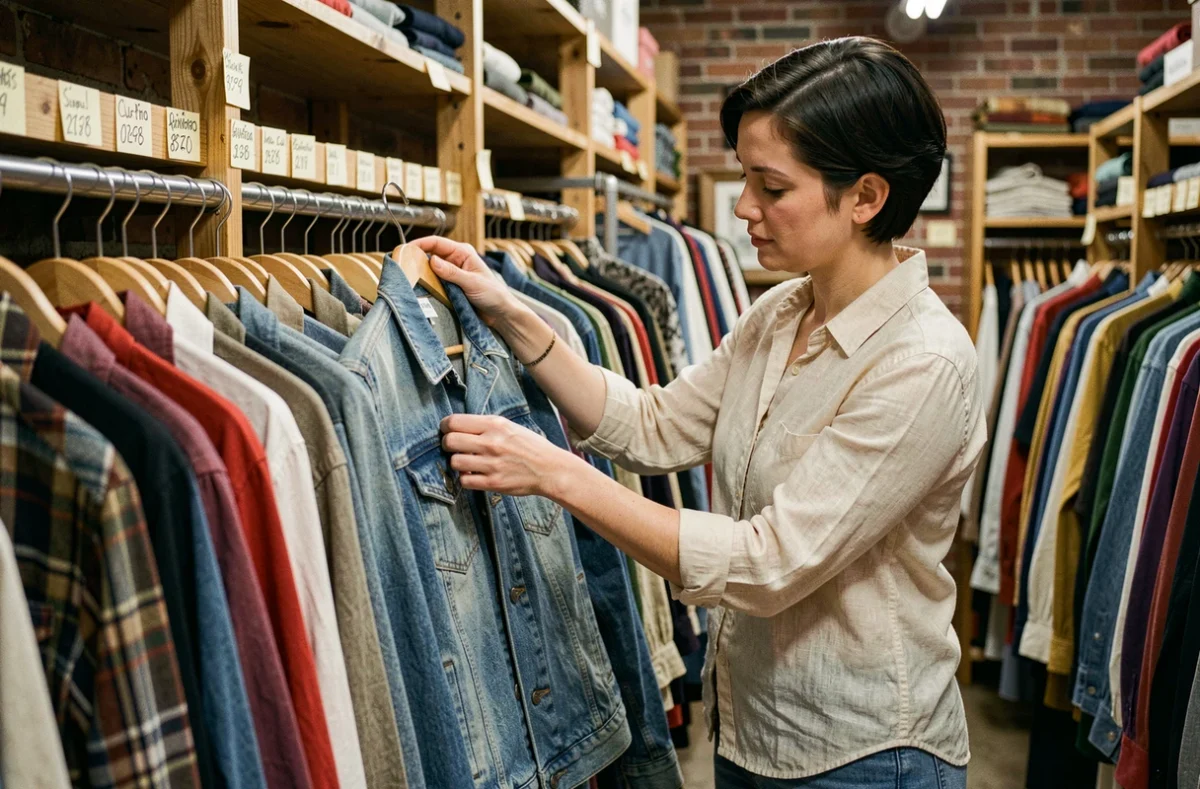
Second-hand clothing accounts for about 7% of textile and shoe consumption in France according to the Refashion 2025 barometer. This figure, still modest, shows that the second-hand market is growing without replacing new items. Buying second-hand clothing requires mastering a few technical reflexes to avoid disappointments, particularly regarding the actual condition of the pieces, the reliability of sizes, and the trap of low prices.
Textile composition and actual condition: what determines the lifespan of a second-hand item
A second-hand garment cannot be judged by its photo. The composition of the fabric directly affects its resistance to wear that has already occurred. An item made of thick cotton or wool retains its properties much longer than a low-quality synthetic blend, even if the latter appears visually intact.
Before making a purchase, check the composition label. A fabric rich in natural fibers ages better than a 100% polyester textile. Fine synthetic fibers pill, lose their elasticity, and retain odors after a few washes, defects that are often invisible in an online listing.
To assess the condition, focus on three priority wear areas:
- The armpits and the crotch, where the fabric experiences the most friction and where the first signs of wear (thinning, emerging holes) appear.
- The seams (shoulders, sides, hems): pull gently to check that they are not loose or coming undone in places.
- The zippers and buttons, which represent the primary repair point on a second-hand garment and whose replacement can cost as much as the item itself in a thrift store.
Several complementary selection criteria are detailed in a file dedicated to second-hand clothing on Ei Mag, which also addresses the issue of quality-condition ratio.
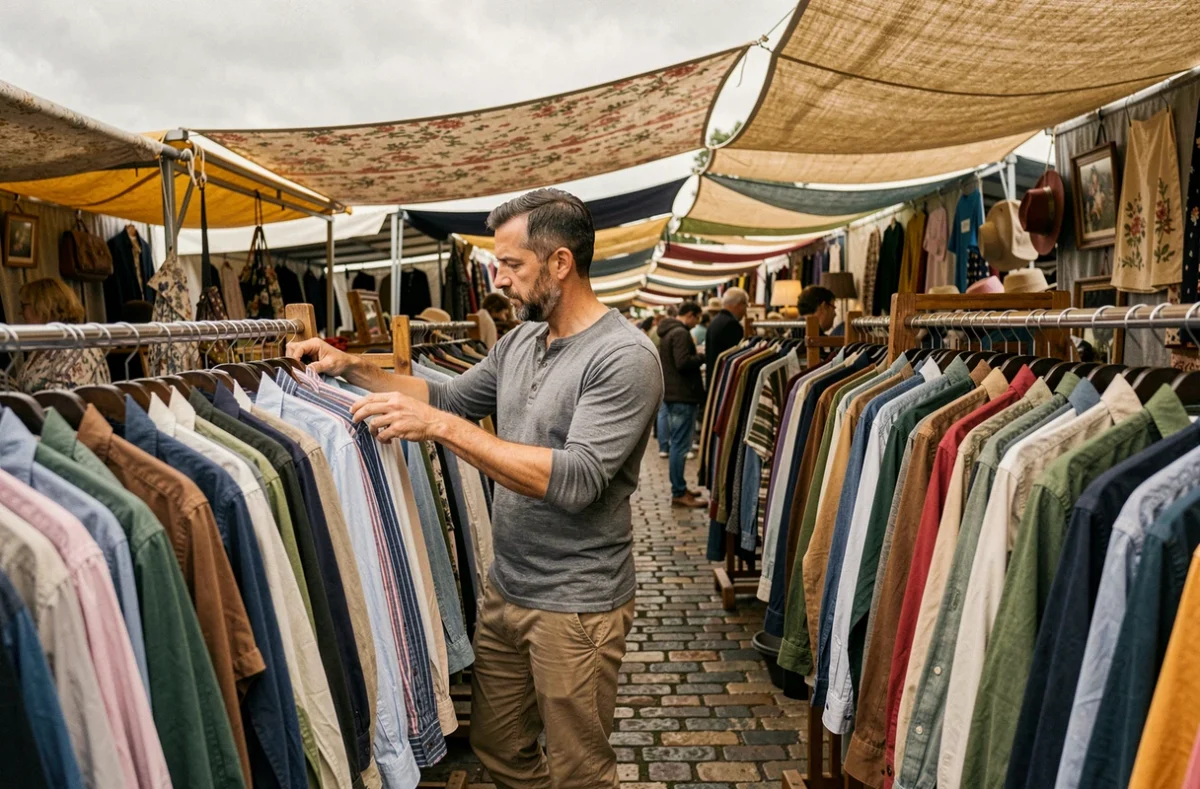
Second-hand size and measurements: why the label is not enough
The size displayed on a second-hand garment is unreliable information. Size standards vary from brand to brand and from decade to decade. A size 38 bought from a French brand in 2015 does not correspond to the size 38 of an Italian brand from 2008.
On online platforms, serious sellers indicate flat measurements: bust circumference, total length, shoulder width, waist circumference. These figures are what matter, not the size marked on the label.
To utilize this data, you need to know your own measurements. Take a measuring tape and note your measurements on a garment that you wear regularly and that fits you well. Then compare these values to those indicated in the listing, adding a margin of one to two centimeters for ease.
A three-centimeter discrepancy in bust circumference is enough to make a jacket unwearable. This measuring reflex avoids the majority of returns and disappointments, particularly for structured pieces like blazers, coats, or jeans.
Second-hand price versus new price: the false good deal
The common reflex is to consider that all second-hand clothing is cheaper than its new equivalent. The Refashion 2025 barometer, reported by Le Figaro, shows that the price of a second-hand item can equal that of a new entry-level garment, depending on the sales channel used.
An item sold on a peer-to-peer platform often includes shipping fees and sometimes a commission. When added together, these costs bring the final price closer to that of a discounted new item from fast fashion.
To assess whether a second-hand purchase is worth it, compare at equivalent quality. A blended wool coat from a recognized brand, sold second-hand at a moderate price, remains a better deal than a new polyester coat at the same price. The relevant criterion is not the face value, but the cost relative to the quality of the fabric and the condition of the item.
Solidarity networks (recycling centers, associative shops) generally offer the lowest prices, but sorting takes more time there. Commercial thrift stores charge higher prices in exchange for a pre-filtered selection. Each channel has its own time-price-quality ratio.
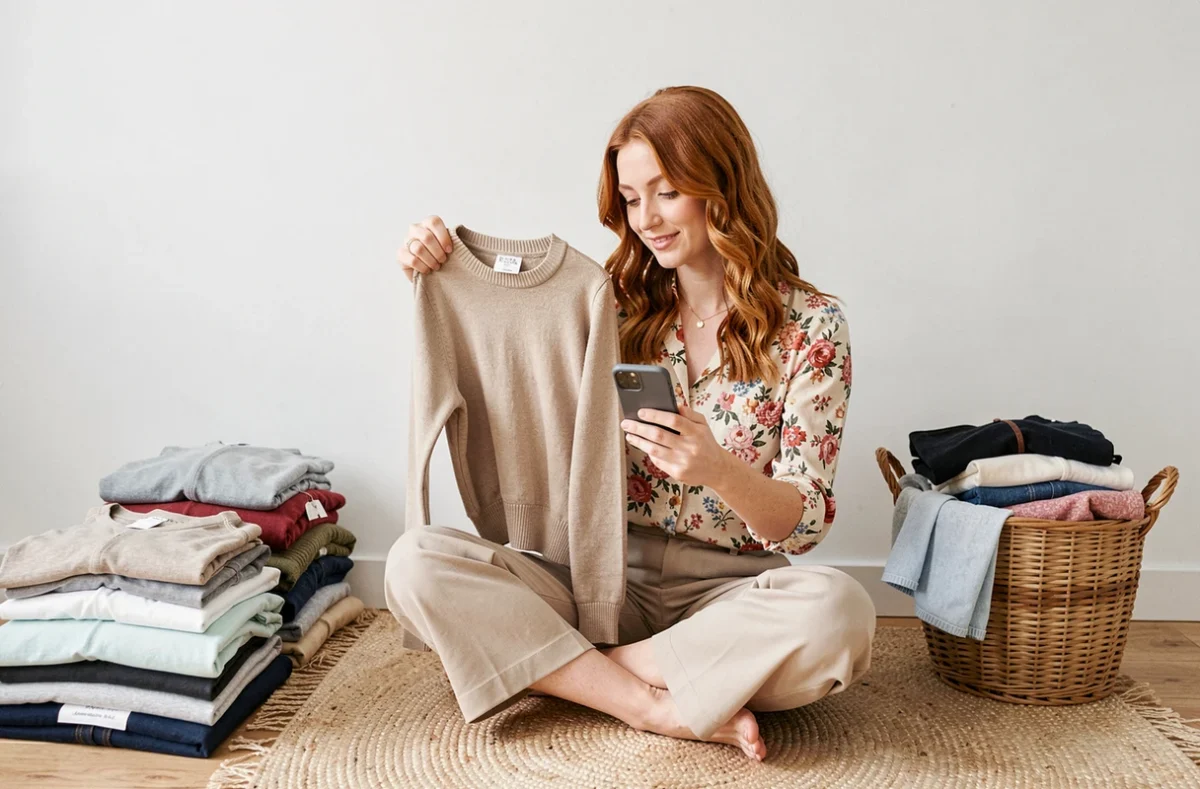
Counterfeiting in second-hand: spotting fakes before buying
Counterfeiting is not limited to the new luxury market. Second-hand circuits remain vulnerable to fake items due to the lack of systematic traceability regarding the origin and labeling of pieces. This observation, highlighted by recent analyses of the sector, applies to both online platforms and physical markets.
A few concrete checks reduce the risk:
- Examine the interior finishes: lining, topstitching, quality of buttons or rivets. A counterfeit almost always shows visible finishing defects inside the garment.
- Request photos of the brand label, the composition label, and, if applicable, the serial number or reference code. The absence of these elements on a supposedly high-end item is a warning sign.
- Compare the asking price with the usual residual value of the brand. A luxury item sold at an abnormally low price, even second-hand, should raise suspicion.
The absence of a composition label is the first sign of a counterfeit or severely degraded item. On platforms, do not hesitate to ask the seller specific questions: purchase date, location, proof of purchase. An honest seller will respond without difficulty.
The law of July 8, 2026, on ultra-fast fashion strengthens the regulatory framework around textile traceability in France. While its effects primarily concern new items, it contributes to structuring the expectations of transparency that are gradually extending to the second-hand market.
Buying second-hand remains a concrete lever to reduce the impact of textile consumption, provided that each purchase is treated with the same rigor as a new purchase. The good deal in second-hand is not the one that costs the least, but the one that lasts.